
Lackawanna County Arrest Records and Charges
An arrest record is tied to the event of arrest or custody. It may involve the arresting agency, booking process, warrant or complaint basis, and jail intake information. Court charge records begin when the criminal accusation is filed in the judicial system. In Lackawanna County, early criminal processing often starts in Magisterial District Court with a complaint, OTN, preliminary arraignment, bail, and preliminary hearing. If the matter is held for court, it moves into the Court of Common Pleas criminal case file.
The custody side should be checked through inmate records and official jail or custody channels. The charge side should be checked through UJS Case Search, the Magisterial District Court docket, and the Criminal Division of the Clerk of Judicial Records. For the full case file, including plea, verdict, disposition, and sentence, use criminal court records. Court charges after arrest can change as the prosecutor reviews the case, amends counts, withdraws charges, or files an information in Common Pleas.
The Lackawanna County Court of Common Pleas page is the source for the assigned court image below.
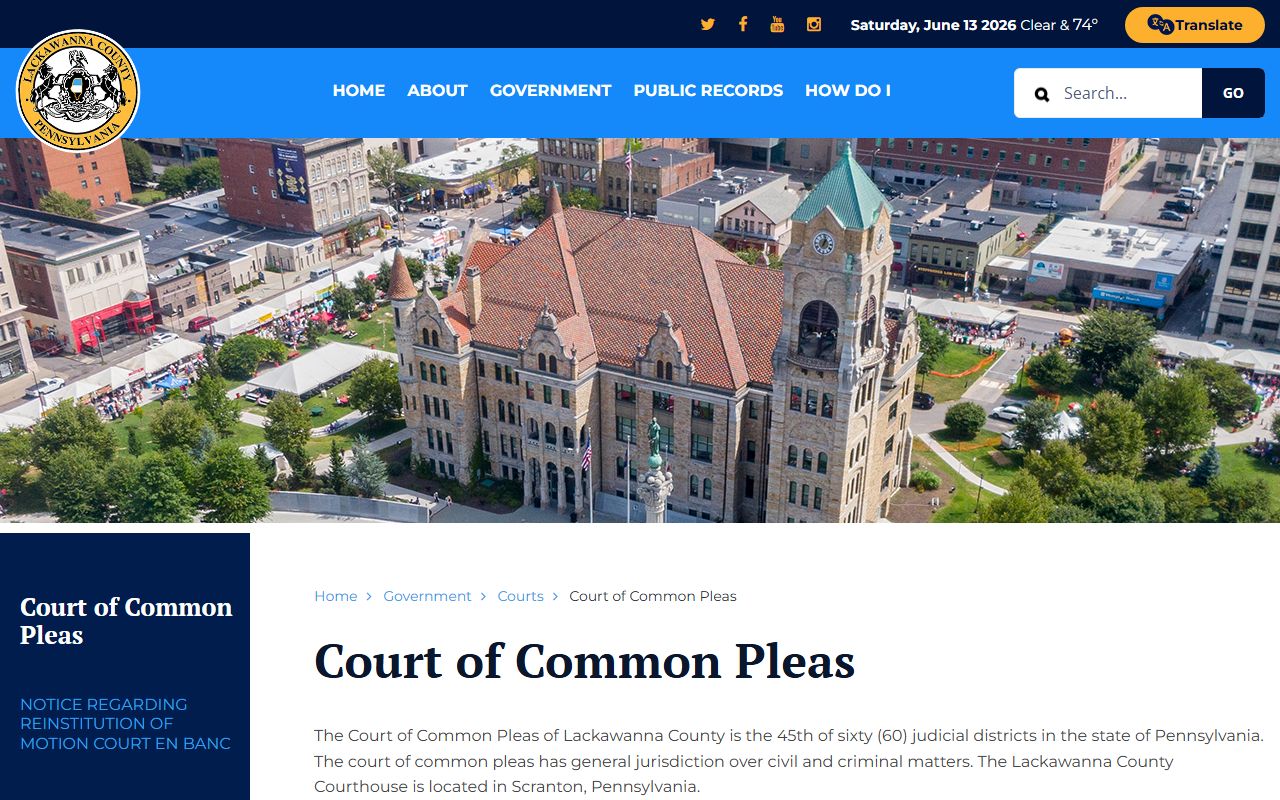
The Court of Common Pleas is where held-for-court criminal charges become part of the broader criminal case record.
Find Arrest Records and Charges
Use Pennsylvania UJS Case Search to search filed charges by participant name, docket number, OTN, complaint number, incident number, citation number, or date filed. An OTN is an offense tracking number used in Pennsylvania criminal processing. A complaint number can help locate early Magisterial District Court activity, while a CP docket number can identify the Common Pleas case after bind-over.
- Search UJS by participant name, OTN, complaint number, or docket number.
- Review the court office to see whether the matter is in Magisterial District Court, Central Court, or Common Pleas.
- Read the charge list by count, statute, grade, offense date, and current disposition.
- Check bail, preliminary hearing, information filed, and later disposition entries before drawing conclusions.
- Request certified copies from the Criminal Division if a formal court record is required.
UJS docket sheets are not a Pennsylvania State Police background check. They can show charges and outcomes, but official criminal-history checks follow state criminal-history rules.
Charges After Arrest Documents
Charges after arrest are documented through criminal complaints and later Common Pleas filings. Pennsylvania county criminal records commonly use complaint numbers, OTN, arresting agency, offense date, filed charges, statute citations, grades, preliminary hearing entries, information filed, disposition, and sentence. The word indictment is common in some legal systems, but Lackawanna County research for this project supports complaint and information as the practical local criminal charging documents.
| Document | Who Files or Creates It | How It Appears Locally |
|---|---|---|
| Complaint | Law enforcement or prosecution through the Magisterial District Court process. | Starts early charge tracking with complaint number, OTN, charges, arresting agency, bail, and preliminary hearing activity. |
| Information | District Attorney after the case is held for Common Pleas. | Formal Common Pleas charging document that lists charges proceeding in the trial court. |
| Indictment | Grand jury in systems or cases using that process. | Not the routine county path identified in the Lackawanna research; do not assume it appears in an ordinary local docket. |
Magisterial Charge Origins
The Magisterial District Courts are central to arrest-to-charge records. Lackawanna County has ten district judges plus a centralized district court. These courts handle preliminary arraignments, bail setting, preliminary hearings, arrest warrants, search warrants, summary traffic and non-traffic offenses, and misdemeanor or felony preliminary processing. Central Court handles countywide preliminary hearings for many misdemeanor and felony cases.
The assigned Magisterial District Courts image comes from the county's official court page.
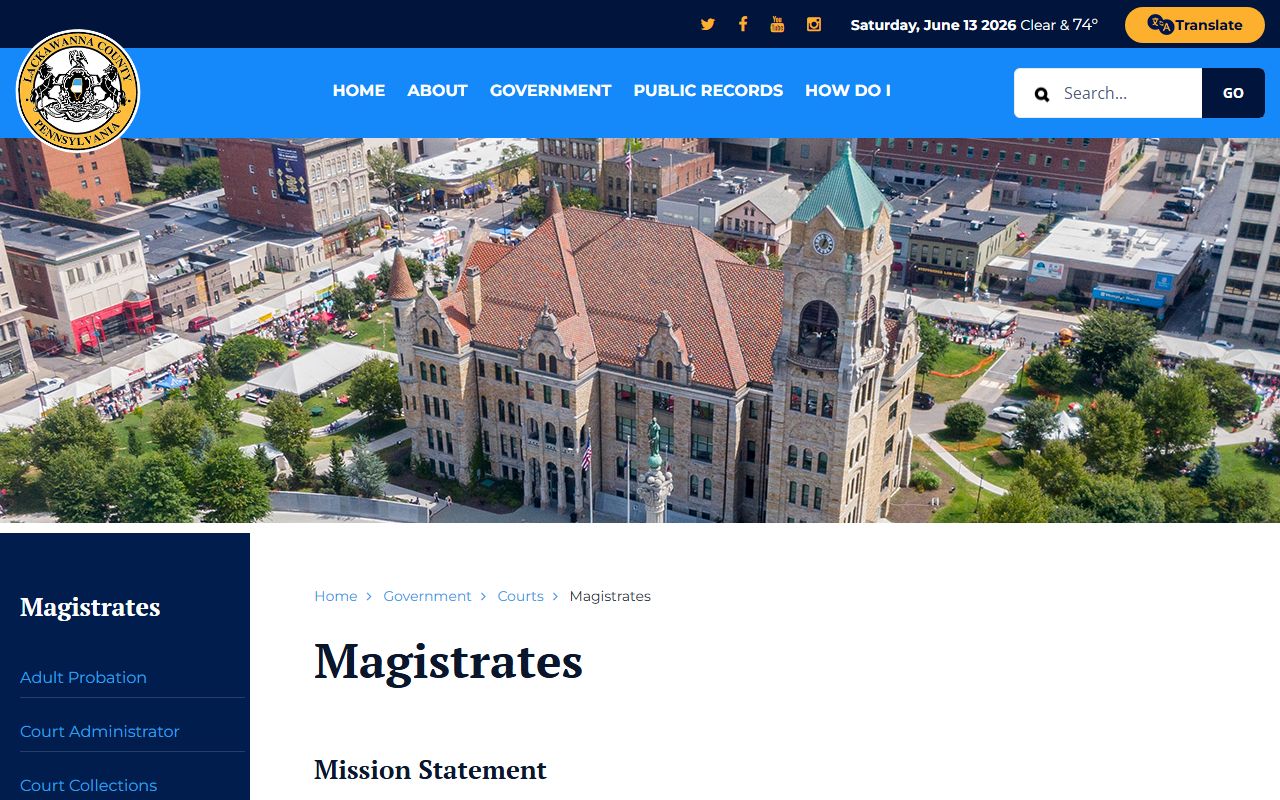
This source explains why early charge records may appear first in a Magisterial District Court docket before the case reaches Common Pleas.
| Local Court Layer | Charge-Record Role |
|---|---|
| Magisterial District Court | Initial complaint, preliminary arraignment, bail, warrants, and preliminary hearing. |
| Central Court | Centralized preliminary hearings and DUI court cases from the county's district courts. |
| Court of Common Pleas | Formal criminal case after bind-over, including information, motions, plea, verdict, sentence, and appeals. |
Charge Status Meanings
A charge list is not static. Counts may be added, amended, reduced, withdrawn, dismissed, held for court, resolved by plea, or disposed after trial. A docket should be read count by count because one offense can be dismissed while another offense in the same case leads to conviction or sentence. Later expungement or limited-access activity can also affect what public users see.
| Status | What It Means |
|---|---|
| Pending | The court has not entered a final outcome for that charge. |
| Held for court | The Magisterial District Court sent the matter forward for Common Pleas handling. |
| Amended or reduced | The filed charge changed, often by grade, statute, count, or negotiated resolution. |
| Withdrawn or dismissed | The charge did not proceed to conviction on that count. |
| Nolle prosequi | The prosecution declined to continue a charge, subject to court rules and case context. |
| Guilty or convicted | The charge reached a conviction-level result by plea, verdict, or other qualifying disposition. |
Charges vs Convictions
Someone can have a public charge record without a conviction. The charge shows that an accusation was filed. A conviction shows that a court entered a guilty outcome or conviction-level result. Lackawanna County arrest records and court charges should always be read with the final disposition and sentencing entry before being treated as resolved.
| Charge | Conviction | |
|---|---|---|
| Meaning | An allegation filed through complaint, information, citation, or related charging document. | A court outcome after plea, verdict, or other conviction-level disposition. |
| Timing | Appears early in the case, often after arrest or complaint filing. | Appears after disposition and often before or with sentencing. |
| Risk of misread | May later be changed, reduced, withdrawn, or dismissed. | Still must be checked for appeal, sentence modification, expungement, or limited access. |
Bail Warrants and Costs
Arrest-to-charge records often intersect with warrants and bail. Magisterial District Judges issue arrest and search warrants, conduct preliminary arraignments, set or accept bail, and process preliminary criminal matters. Lackawanna County's Sheriff warrant page groups criminal warrants, domestic relations warrants, and fines/costs warrants. Court Collections states that failure to appear at contempt hearings for fines and costs can result in a bench warrant filed with the Sheriff.
The Court Collections page is assigned to the arrest and court charge record set.
Court Collections matters can add later warrant and payment entries to a criminal court record after the original charge has already been resolved.
Note: Payment or docket activity may not cancel a warrant until the court or Sheriff processes it.
Restricted Arrest Records and Charges
Public access has limits. UJS warns that juvenile, expunged, limited-access, and some civil records may not display. PAePay excludes sealed or secured cases, pending expungement cases, minor defendants, redacted captions, and some cases with no online balance. Court public-access policy may redact personal identifiers, abuse-victim details, minor names, and sensitive information. A sealed warrant, protected investigation, juvenile matter, or expunged charge may be withheld from public search tools.
| Sealed or Limited Access | Expunged | |
|---|---|---|
| Public display | Hidden or restricted from ordinary public lookup. | Removed from public access after eligibility and court process. |
| Record still exists | May remain available to courts or authorized agencies. | May be treated as removed from public records, with limited criminal justice retention rules. |
| How to verify | Contact the court or counsel if legally entitled to information. | Use the docket, clerk, and court order history to confirm the exact relief granted. |
Statewide Charge Lookups
UJS Case Search is a public docket tool. It is not the official Pennsylvania criminal-history background check system. UJS warns employers that docket sheets are not a substitute for a criminal-history record check under Pennsylvania law. For case research, UJS can show court charges after arrest and later dispositions. For official background-screening use, users must follow Pennsylvania State Police criminal-history procedures and any employment, housing, licensing, or FCRA-related rules that apply.
The Lackawanna County District Attorney, Public Defender, Sheriff, prison, Magisterial District Courts, and Criminal Division each have different roles. The DA prosecutes. The Public Defender handles indigent defense applications. The Sheriff handles warrants and court security. The prison handles custody services. The Clerk of Judicial Records keeps the court file. Matching the question to the correct office prevents bad assumptions from a single charge entry.