
Lackawanna Criminal Court Records
A criminal court record is the case-level record kept by the court once charges enter judicial processing. In Lackawanna County, the Criminal Division of the Clerk of Judicial Records, also known as Clerk of Courts, maintains criminal Common Pleas filings at the courthouse. Magisterial District Courts and Central Court create the early docket trail for preliminary arraignments, bail, preliminary hearings, warrants, and misdemeanor or felony processing before a case reaches the Court of Common Pleas.
The Court of Common Pleas hears adult and juvenile criminal prosecutions, specialty court matters, appeals from special courts, and criminal proceedings tied to probation, sentence, fines, costs, and post-disposition events. Magisterial District Judges handle summary offenses, preliminary criminal proceedings, arrest warrants, search warrants, emergency relief, and bail. Central Court at the Criminal Justice Center was established to process preliminary hearings from the county's ten district courts in one countywide setting.
The Lackawanna County District Attorney page is one of the assigned source images for criminal court records.
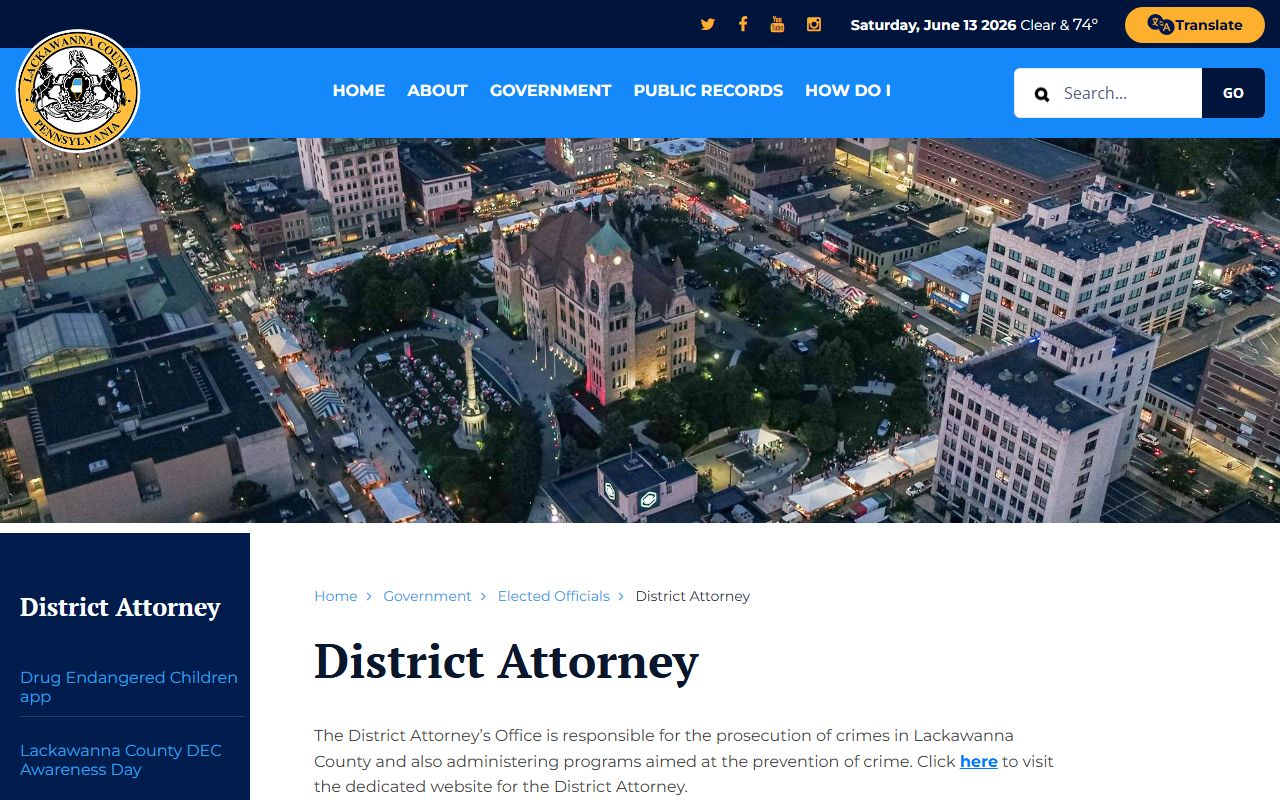
The District Attorney's Office prosecutes county crimes, but certified criminal case copies come from the court clerk rather than the prosecutor.
Search Lackawanna Criminal Court Records
Use Pennsylvania UJS Case Search for public criminal docket sheets. Search by participant name, docket number, OTN, complaint number, incident number, attorney, or date filed. Common Pleas criminal docket numbers use a CP format, and Magisterial District Court docket numbers use an MJ format. UJS is free, but it warns that recent filing-office entries may be delayed and that docket sheets are not official criminal-history background checks.
- Open UJS Case Search and choose participant name, docket number, OTN, or complaint number.
- Select Lackawanna County if a county field appears, then enter the exact case or party information.
- Open the criminal docket sheet and review charges, bail, court office, event history, and disposition.
- Check whether the case began in Magisterial District Court and later moved to Common Pleas.
- Request certified copies from the Criminal Division of the Clerk of Judicial Records when an official copy is needed.
For a closer look at the charge list itself, use arrest records and court charges. For broader civil, family, probate, and traffic paths, use court records. Jail custody status belongs with inmate records, and active warrant questions belong with warrant records.
Criminal Case Flow
Criminal cases in Lackawanna County often begin in the Magisterial District Court system with a complaint, preliminary arraignment, bail decision, and preliminary hearing. If the case is held for court, it moves to Common Pleas, where formal arraignment, motions, plea negotiations, trial settings, disposition, sentencing, and post-sentence events appear. Each step can create a docket entry.
Case flow: Charges Filed › Preliminary Arraignment › Bail and Preliminary Hearing › Information Filed › Pretrial Motions › Plea or Trial › Disposition › Sentencing
| Stage | What Happens |
|---|---|
| Preliminary arraignment | A Magisterial District Judge addresses initial process and may set bail conditions. |
| Preliminary hearing | The MDJ decides whether the case should be held for Common Pleas review. |
| Information filed | The prosecutor files the formal Common Pleas charging document after bind-over. |
| Pretrial and motions | The court handles continuances, discovery disputes, suppression issues, plea talks, and orders. |
| Plea or trial | The case resolves by plea, verdict, dismissal, withdrawal, or another court disposition. |
| Sentencing | The court imposes sentence, probation, fines, costs, restitution, and related conditions where applicable. |
What Criminal Records Show
A Lackawanna County criminal court record can show the accusation, court action, and outcome. The docket may list the OTN, complaint number, arresting agency, offense date, charges, statute citations, grade, bail, preliminary hearing, information, formal arraignment, motions, orders, plea, verdict, sentence, costs, and appeal activity. Some entries are short. Others point to filed documents that may require a clerk request.
| Field | What It Shows |
|---|---|
| Docket number | The Common Pleas or Magisterial District Court case number tied to the criminal matter. |
| OTN and complaint number | Pennsylvania identifiers used to track the offense and charging process. |
| Charges | Filed offenses, statute sections, grades, and later changes or dispositions by count. |
| Bail | Release conditions, monetary bail, or bail-related docket activity where public. |
| Plea or verdict | The defendant's formal plea or the result reached after trial. |
| Disposition and sentence | The outcome and court-imposed penalty, including probation, fines, costs, restitution, or custody terms where listed. |
DA and Defense Offices
District Attorney Brian Gallagher is responsible for prosecuting crimes in Lackawanna County. The DA page lists units for detectives, domestic violence, child abuse, sexual assault, drug matters, DUI, juvenile matters, auto theft, victim/witness services, insurance fraud, and elder abuse and neglect. The DA initiates or prosecutes the charges that appear in criminal court records, but the DA's office does not replace the Criminal Division for court copies.
The Lackawanna County Public Defender page is shown in the assigned image below.
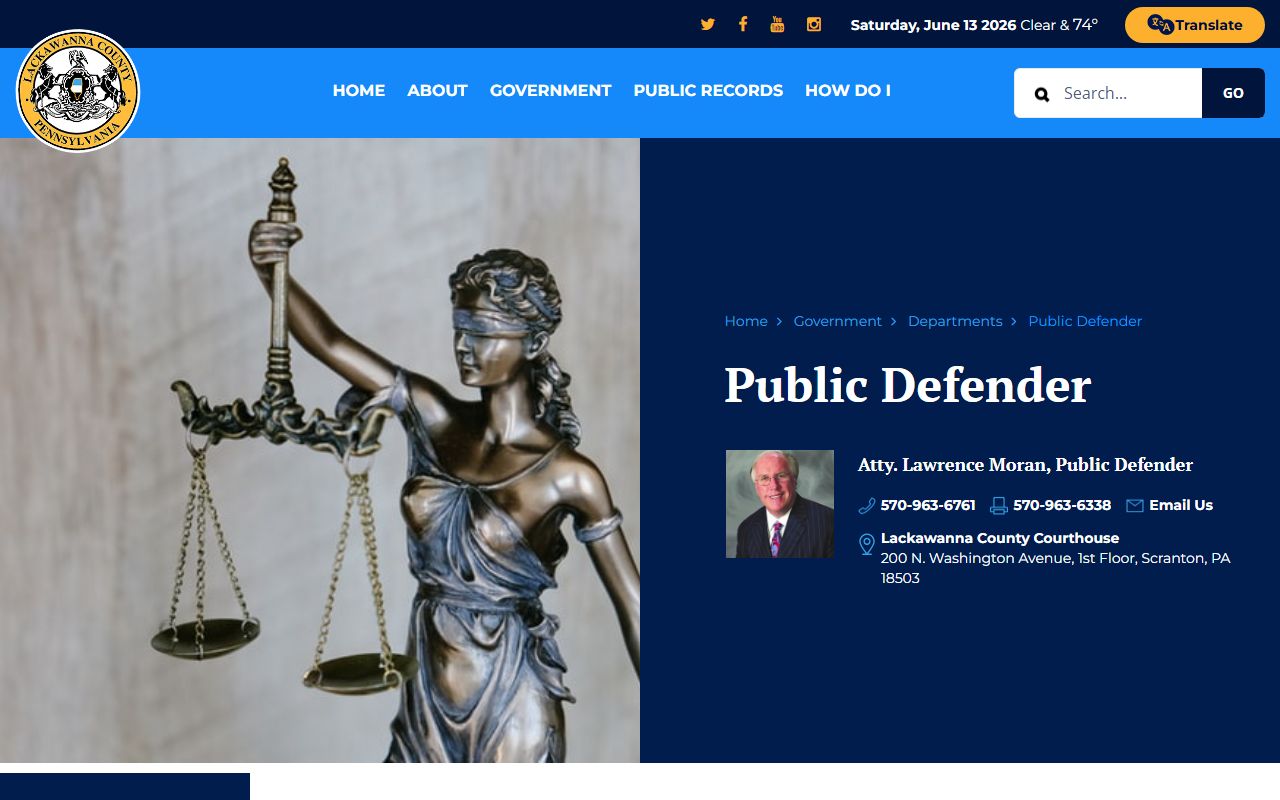
The Public Defender represents adults charged with criminal offenses who are found indigent, and applicants must provide proof of income and charge papers.
Lackawanna County District Attorney
135 Jefferson Avenue
Scranton, PA 18503
570-963-6717
Lackawanna County Public Defender
200 North Washington Avenue, First Floor
Scranton, PA 18503
570-963-6761
Charges vs Convictions
A criminal court record may list charges that never became convictions. A charge is an accusation filed in court. A conviction is the result of a guilty plea, guilty verdict, or other conviction-level disposition. One case can contain several counts, and each count may have its own status. Some counts can be dismissed while others result in sentence.
| Charge | Conviction | |
|---|---|---|
| Meaning | An offense alleged by complaint, information, or other charging document. | A final court result based on plea, verdict, or conviction-level disposition. |
| Record location | Often appears early in MDJ and Common Pleas dockets. | Appears in disposition and sentencing entries. |
| Use caution | May be amended, withdrawn, dismissed, reduced, or held for court. | Still must be read with sentence, appeal, and later expungement or limited-access activity. |
Sentences and Specialty Courts
Sentencing entries can include probation, costs, fines, restitution, treatment conditions, restrictive probation, DUI treatment, mental health court requirements, or other supervision. Lackawanna County Adult Probation lists ARD, restrictive probation, DUI treatment, mental health, veterans, and Gagnon court programs. A Gagnon proceeding is tied to probation or parole violation process and can create later entries after sentencing.
The Adult Probation page is included in the criminal court records image set.
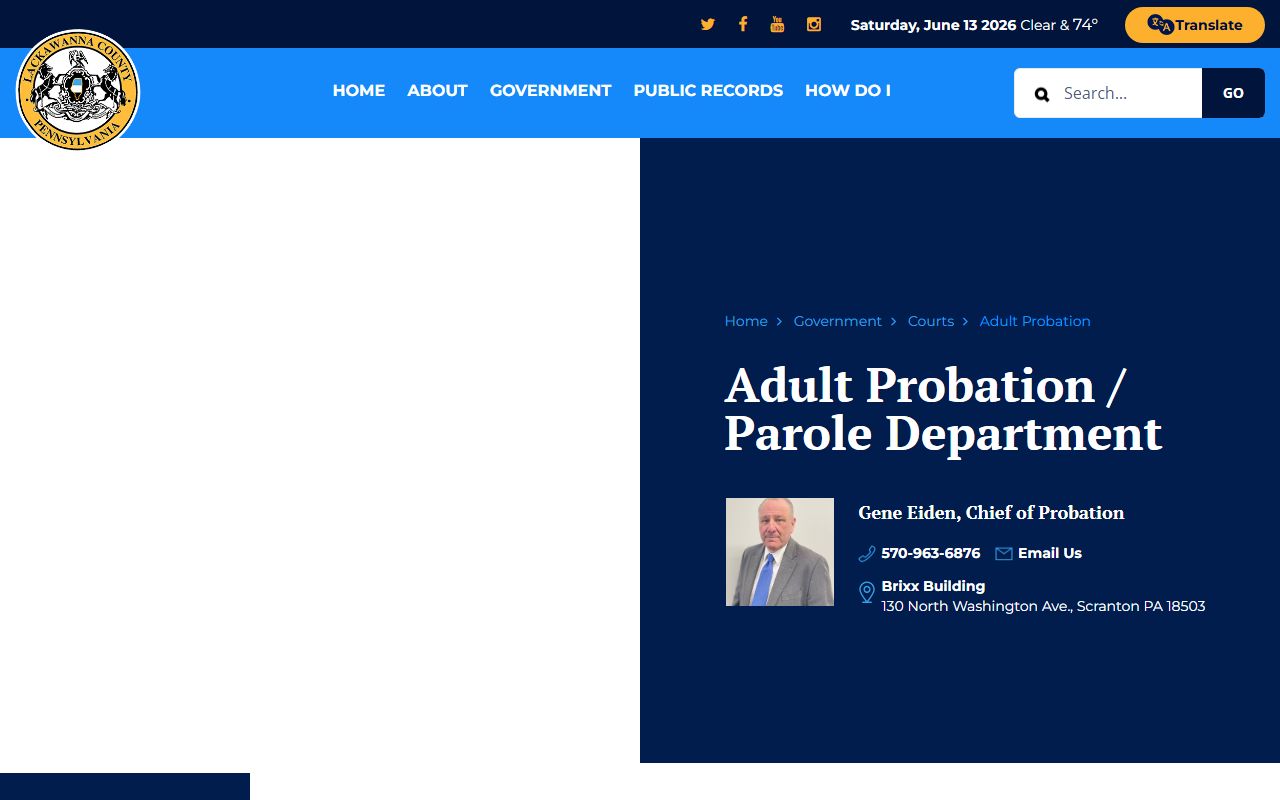
Probation-related entries can explain why a criminal case remains active after sentencing or why a violation hearing appears later.
The county's Treatment Court page is also assigned to this page.
Treatment Court and related specialty programs may affect case timing, conditions, and docket events, but eligibility is decided through court screening.
Sealed vs Expunged Records
Public criminal court access has limits. UJS lists juvenile, expunged, and limited-access cases as categories that may not display. Pennsylvania limited access can hide eligible matters from public view while still allowing certain agencies to see them. Expungement can remove eligible records from public access after a court process. Eligibility depends on the exact charge, disposition, age of the case, later criminal history, and applicable law.
| Limited Access or Sealed | Expunged | |
|---|---|---|
| Public visibility | Hidden or restricted from public search results. | Removed from public access after a court order or qualifying process. |
| Who may still see it | Certain courts, law enforcement, or authorized agencies may retain access. | Access is more limited, but criminal justice retention rules may still apply. |
| How it starts | By statute, Clean Slate-related process, or court order. | By eligibility review and required court filings or qualifying statutory process. |
Note: A missing public docket does not prove that no case ever existed.
Public Access to Criminal Records
UJS docket sheets are public for many criminal matters, but the Pennsylvania public access policies and the Pennsylvania Case Records Public Access Policy control what appears online. The Pennsylvania Right-to-Know Law applies to many agency records, but court case records follow court access rules. A Right-to-Know request does not override sealing, expungement, juvenile confidentiality, or protected personal identifiers.
UJS also cites the Criminal History Record Information Act in warnings to employers. A public docket sheet should not be used as a substitute for an official Pennsylvania State Police criminal-history check when a lawful background check is required.